
Lee County Court Records After Arrest
A Lee County jail arrest creates a booking record first. That booking record may show the booking date, arresting agency, initial offense field, bond or fine columns, and charge rows. The court record is a different record stream. It starts when the charge is filed in the proper court and continues through pleas, orders, indictments, motions, dismissal, trial, sentence, or appeal.
The starting facts usually come from the jail roster: name, booking date, arresting agency, and any visible charge or bond field. Current custody and booking information belongs on Lee County jail inmate records. Booking photos and profile image issues belong on Lee County jail mugshots. Court records after a Lee County arrest focus on the filed case, the clerk record, and the charge status after the jail intake event.
Lee County has several possible court routes. Justice Court handles many initial misdemeanor and lower-court matters. County Court has concurrent misdemeanor jurisdiction and handles appeals from Justice and Municipal Courts. Circuit Court handles felony-level cases and general court docket records through the Circuit Clerk. The prosecutor also matters because initial booking language can change once a charge is reviewed.
Find Lee County Court Records After Arrest
The online court-record channel is Mississippi Electronic Courts. MEC provides official access to case information, but full online case viewing requires registration and account access. When MEC does not return the needed record, the clerk counter is the practical fallback. For Lee County Circuit Court, the First Circuit courthouse page lists the Lee County Justice Center, Circuit Clerk Camille Roberts Dulaney, and clerk phone lines.
- Start with the jail roster to collect the booking date, name spelling, arresting agency, and any case or charge clues.
- Decide which court likely has the matter: Justice, Municipal, County, or Circuit Court.
- Use MEC if registered, or contact the appropriate clerk with the name, date of birth if known, arrest date, and agency.
- Read the filed charging document and docket entries, not only the jail roster charge line.
- Check whether the charge is pending, amended, dismissed, indicted, pleaded, tried, or sentenced.
The First Circuit Court courthouse page lists Lee County Circuit Clerk contacts at the Lee County Justice Center. The first-floor line is 662-432-2300, and the second-floor line is 662-432-2320. Circuit Clerk office hours from the local clerk site are Monday through Friday, 8:00 a.m. to 5:00 p.m.
The official Mississippi Electronic Courts page is the statewide portal for electronic court access and registration information.
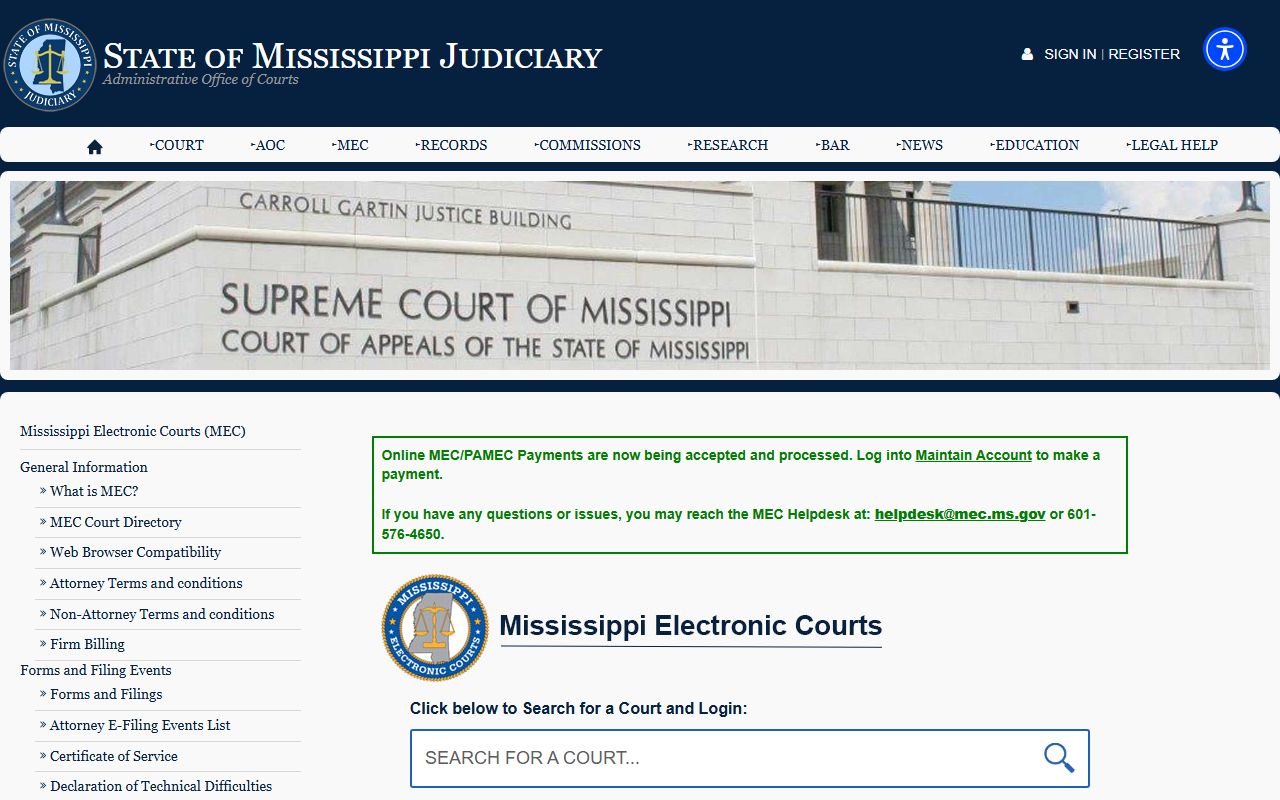
MEC is useful for case records, while the jail roster remains the custody source for current booking and release status.
Lee County Courts After Jail Arrest
After a jail arrest, the right court depends on the offense, arresting agency, and procedural stage. The Lee County Justice Court page states that criminal court is held at 1:30 p.m. Tuesday and Thursday, with court-date questions directed to 662-432-2500. Lee County Court describes concurrent jurisdiction with Justice Court in misdemeanor matters and criminal appeals from Justice and Municipal Courts. Circuit Court handles felony matters and keeps the broader court docket through the Circuit Clerk.
| Court or Office | Lee County Role | Access Point |
|---|---|---|
| Justice Court | Many initial misdemeanor and lower-court criminal matters | County Justice Court page, 662-432-2500 |
| County Court | Concurrent misdemeanor jurisdiction and appeals | Lee County Court site |
| Circuit Court | Felony-level records, indictments, docket, and court orders | Lee County Circuit Clerk, 662-432-2300 |
| District Attorney | Felony prosecution decisions in the First Circuit | Tupelo office, 302 Franklin Street, 662-432-2802 |
Charges Filed After a Lee County Arrest
Booking charges are not always the final court charges. A law-enforcement officer may bring a person to jail on one description, then the prosecutor or grand jury may file a different charge. In Lee County felony matters, the First Circuit District Attorney's office is part of that pathway. Research identified Jason D. Herring as District Attorney for Mississippi's First Circuit Court District after the September 27, 2024 appointment announcement.
| Document | Who Usually Files It | How It Fits After Arrest |
|---|---|---|
| Complaint | Officer or prosecutor | Often starts a lower-court criminal case after arrest. |
| Information | Prosecutor | Can state formal charges without grand-jury indictment where allowed. |
| Indictment | Grand jury | Common felony charging document in Circuit Court. |
The DA's Tupelo office listed in official sources is at 302 Franklin Street, Tupelo, MS 38802, with phone 662-432-2802. The First Circuit covers Alcorn, Itawamba, Lee, Monroe, Pontotoc, Prentiss, and Tishomingo counties, so a Lee County felony court record sits inside a larger northeast Mississippi prosecution district.
Lee County Charge Status Records
Charge status can change more than once after a Lee County jail arrest. The jail profile may show a booking charge or N/A fields, but the court docket may later show a filed complaint, indictment, plea, dismissal, order, or sentence. The safest read is to treat the roster as the arrest and custody record, then use the court record for what the legal case became.
| Status | Meaning in a Court Record |
|---|---|
| Pending | The charge or case is open and no final disposition is shown. |
| Amended | The filed charge was changed by the court or prosecutor. |
| Reduced | The charge level or offense was lowered from an earlier version. |
| Dismissed | The court record shows the case or charge was ended without conviction. |
| Indicted | A grand jury returned a felony charging document. |
| Convicted | A guilty plea, verdict, or adjudication resulted in conviction. |
Bond After Lee County Jail Arrest
The Lee County roster has Bond Amount and Fine Amount columns when charge information is populated, but the sheriff pages reviewed did not publish a full local bond-payment instruction page. For a bond question, check the roster profile, then call Adult Jail/Corrections at (662) 432-2632 or the sheriff main line at (662) 432-2600. Another hold can block release even when one visible charge has a money amount.
| Bond or Hold Type | How It Works |
|---|---|
| Cash bond | Money is posted directly in the amount ordered by the court. |
| Surety bond | A licensed bail agent posts a bond for the defendant. |
| Recognizance or PR bond | The person is released on a promise to appear. |
| No-bond hold | Money bond will not release the person until the hold is resolved. |
| Detainer | Another agency has placed a custody hold or wants the person held. |
Warrants and Lee County Arrest Records
No official Lee County active-warrant searchable database was located in the sheriff pages reviewed. The sheriff site has a Most Wanted page, and the sheriff app advertises Wanted Persons and tip features, but those are not the same as a complete public warrant search. The county FAQ says cases with active warrants are not public information in the background-search context, so a missing online warrant result should not be treated as proof that no warrant exists.
A warrant can lead to a booking record if the person is arrested. The roster may then show the person as recently booked or currently in custody. A bench warrant may come from failure to appear or failure to obey a court order. An arrest warrant authorizes arrest on a charge. A search warrant authorizes a search and is not an inmate lookup tool. Questions about a court-issued warrant should go to the issuing court or counsel rather than guessing from the jail roster alone.
Charges vs Convictions
An arrest and charge are not the same as a conviction. A Lee County jail booking records that a person was taken into custody. A court charge records what the case alleges. A conviction requires a plea, verdict, or other court finding. This distinction matters for employment, housing, licensing, and any decision where an accusation should not be treated as proof.
| Charge | Conviction | |
|---|---|---|
| Stage | Accusation filed or listed after arrest | Final finding after plea, verdict, or disposition |
| Meaning | Alleged conduct | Legal outcome |
| Where Seen | Jail roster, complaint, indictment, docket | Judgment, sentence, disposition entry |
| Can Change | Yes, charges may be amended, reduced, or dismissed | Changes require appeal, set-aside, or other court action |
Sealed and Expunged Lee County Records
Mississippi public-records law starts with access, but it does not make every criminal or jail-related record open forever. Juvenile records, active investigative reports, sealed cases, expunged cases, and some active-warrant information may be limited. Mississippi Code Section 25-61-3 distinguishes investigative reports from basic public-record categories, and Section 25-61-5 addresses response and denial rules.
| Sealed | Expunged | |
|---|---|---|
| Public Access | Hidden or restricted from ordinary public view | Removed from public access if the court grants relief |
| Route | Court order or legal restriction | Petition under qualifying Mississippi law |
| Lee County Step | Check the court that handled the case | Use the court with jurisdiction over the arrest or case |
| Key Law | Depends on record type | Mississippi Code Section 99-19-71 |
Public Access Limits After Arrest
Mississippi Code Section 25-61-1 states the public-records access policy, and Section 25-61-7 allows agencies to charge costs tied to providing records. Lee County sheriff records fees include $5 for a background or records check, $5 for the first arrest/release form, and $1 for each additional copy. Those fees apply to records functions, not necessarily to court copies or bond payments.
Important: Court records after arrest may be incomplete online, and active, sealed, juvenile, or investigative records may require clerk confirmation.
Public Record Search
Sponsored Results